Nextcloud for a Legal Practice
Secure Document Management, Search and e-Signing on Australian Infrastructure
The client
A small Australian legal practice engaged Velocity Host to modernise how the firm stores, finds, signs and collaborates on documents. Like most firms of its size, it had accumulated a patchwork of tools: a shared drive of scanned PDFs nobody could search, a third-party e-signature subscription billed per envelope, email threads standing in for internal communication, and client records spread across spreadsheets and paper registers.
The firm needed one platform that covered document management, search, signing, communication and matter administration — hosted in Australia, under its own control, without per-feature subscription creep.
The challenge
- Scanned documents were dead weight. Court documents, correspondence and executed agreements arrived as scanned PDFs — images, not text.
- Finding a clause meant knowing which file it was in and reading it.
- e-Signing was a recurring cost. Third-party signature platforms charge per user, per envelope, or both, and the signed documents live on someone else’s servers.
- No single source of truth. Matter information lived in spreadsheets, precedents in folders, tasks in inboxes.
- Confidentiality obligations. Legal practices carry strict duties around client confidentiality, document retention and access control. A US-hosted consumer file-sharing product was not an acceptable answer.
The solution: managed Nextcloud on Australian infrastructure
Velocity Host deployed a dedicated, hardened Nextcloud instance for the firm on Australian infrastructure, with the firm’s data on ZFS storage with snapshots and replication. Every capability below is a standard part of the platform — no third-party SaaS bolt-ons, no data leaving the environment.
The document lifecycle, end to end
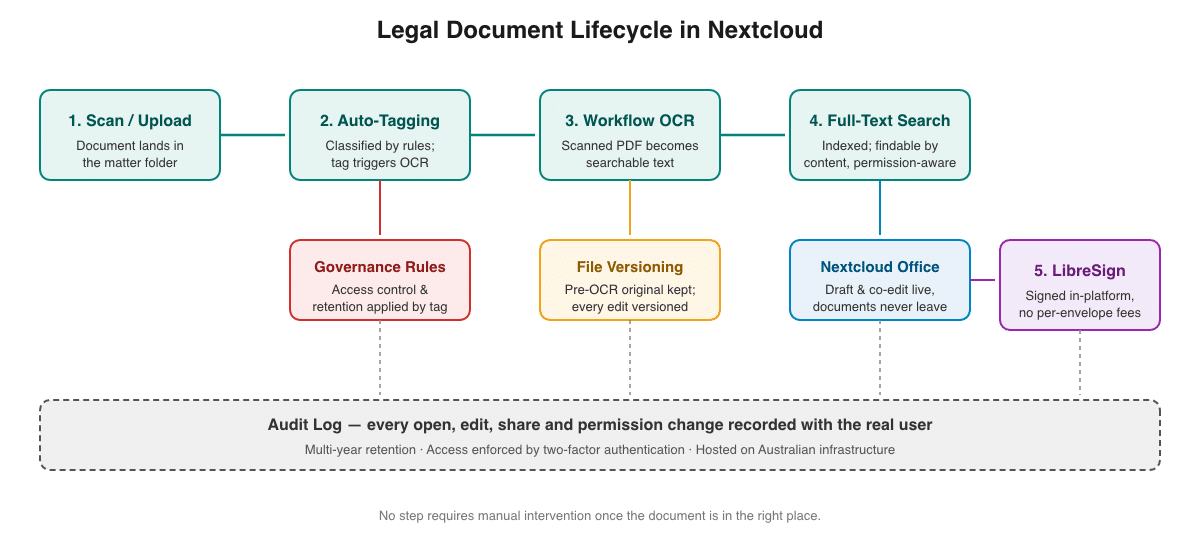
Workflow diagram: legal document lifecycle in Nextcloud — scan and upload, automated tagging, OCR, full-text search, with file versioning, governance rules, Nextcloud Office and LibreSign branches, all recorded in the audit log.
The pieces above chain into one pipeline:
- A document is scanned or uploaded into the matter folder.
- Automated tagging classifies it and triggers OCR.
- OCR makes it searchable; the pre-OCR original is kept as a version.
- Full-text search indexes the content, respecting access permissions.
- Access control and retention rules apply automatically based on its tags.
- If it needs execution, it’s signed via LibreSign and the signed copy is retained.
- Every touch along the way is written to the audit log.
No step requires a person to remember to do anything beyond putting the document in the right place.
Outcomes
- Every document in the firm is findable by its content, including years of historical scans, with search results filtered by each user’s permissions.
- Per-envelope e-signature fees eliminated — signing is now a platform capability, not a subscription.
- One platform replaced separate products for file storage, e-signing, video conferencing, team chat, task tracking and the firm’s paper registers.
- Retention, access control and audit obligations are enforced by the platform, not by policy documents and good intentions.
- All data on Australian infrastructure, on storage with snapshots and replication, under a managed service — the firm knows where its clients’ information is.
Why this matters for professional services firms
Legal practices are the clearest case, but the pattern applies to any firm holding confidential client records with retention and access obligations — accountants, financial advisers, medical and allied health practices, strata and property managers. The building blocks are the same: automated document classification, OCR and search; enforced access rules and retention; digital signing; and communication that stays inside the platform.
Velocity Host deploys and manages this as a per-user service on Australian infrastructure, with the Governance Pack, full-text search, signing and collaboration add-ons available per practice. If your firm is weighing up how to consolidate its document, signing and communication tools without handing its client data to a stack of overseas SaaS providers, this is the model.
More case Studies
A business running everything through remote desktop moved daily work to Nextcloud, retired Exchange, kept one Windows only accounting application on a much smaller remote desktop footprint, and gained replication to a second site.
A small legal practice replaced a shared drive of unsearchable scanned PDFs, a per-envelope e-signature subscription and a scatter of spreadsheets with one Nextcloud platform. Documents are now found by their content, signing is a platform feature rather than a recurring fee, and client data stays on Australian infrastructure.